

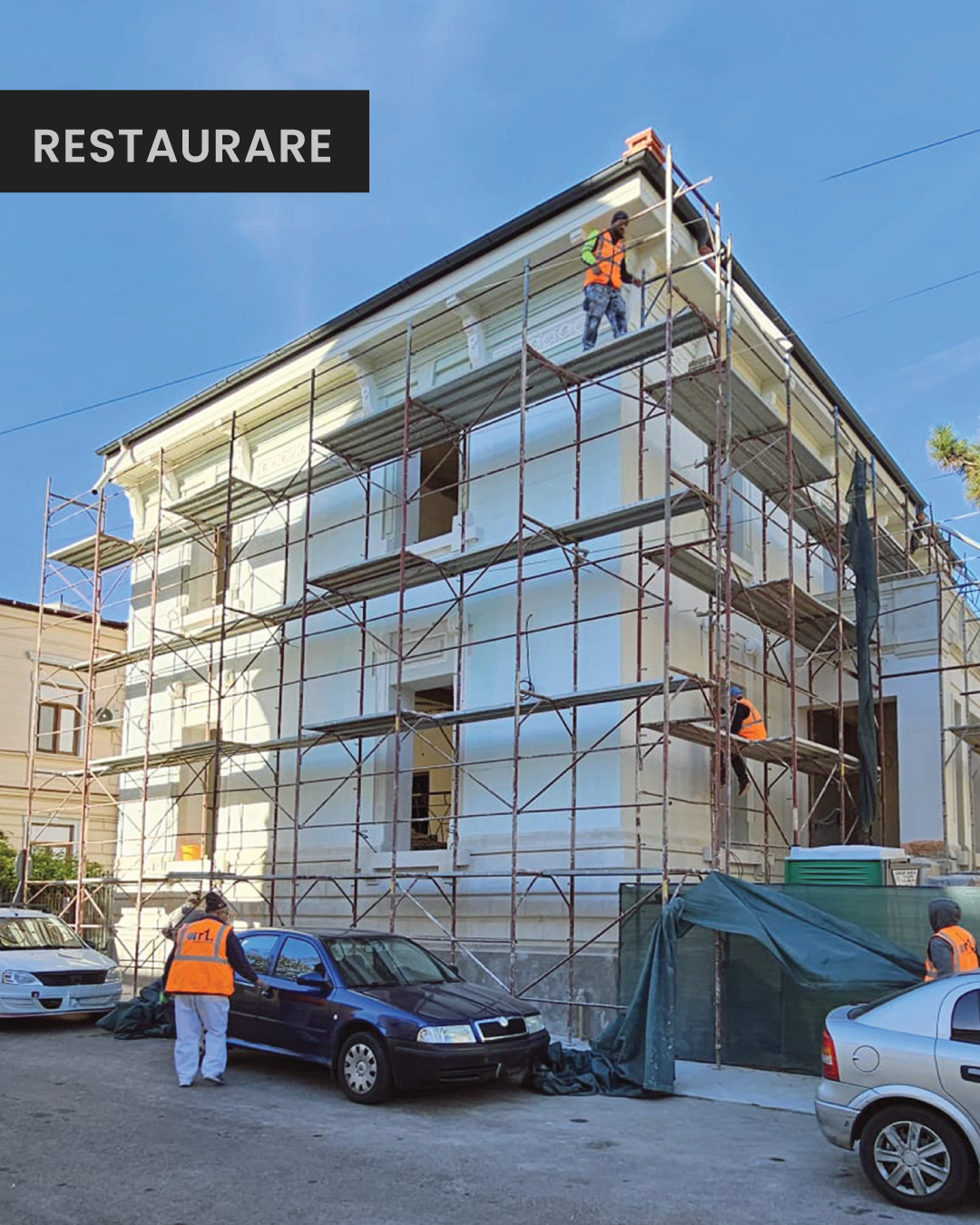
Reconstructing the memory of a historic home, adapted to contemporary standards of comfort, safety, and energy efficiency.
The house located on Constantin Stahi Street is a single-family residence built between 1912 and 1920 — a representative building of early 20th-century Bucharest architecture. With a total area of 864.62 sqm, the structure includes a basement, ground floor, first floor, and attic.

Emerging sustainable materials rewrite architecture
For centuries, architecture and construction were defined by an apparently stable relationship with materials. Stone, wood, steel, and concrete were the pillars on which we built cities, bridges, and homes. But in recent decades, this landscape has fundamentally shifted. Climate pressure, energy crises, and the responsibility owed to future generations

Design & Build permanently replaces the old Design–Bid–Build system
In the world of construction and architecture, paradigm shifts don’t happen overnight. But when they do occur, they fundamentally reshape how projects are conceived, organized, and delivered. Over the past few decades, one of the most profound transformations has been the shift from the traditional Design–Bid–Build model to the integrated

Attention to detail changes the outcome in large-scale projects
Attention to detail in large-scale projects is the only pragmatic way to deliver repeatable quality, to reduce risks, to respect budgets, and to provide an experience that remains coherent over time.

BIM is the Mandatory Language of Modern Projects
Construction material costs fluctuate rapidly, deadlines are increasingly tight, and standards for sustainability, efficiency, and transparency are now demanded by both clients and authorities. For us and our clients at ADB, Building Information Modeling (BIM) has become the baseline standard for any project. The history of BIM begins with the pursuit

Why are people moving to the edges of cities? The peri-urban, ground zero of contemporary architecture.
The peri-urban is not the edge of the city, but an in-between space that is increasingly becoming the scene of major transformations. Here, new neighbourhoods, industrial parks, private schools, logistics hubs, and gradually even communities that function almost independently are emerging. In many countries, the peri-urban is already the growth

How to build with simplicity during complicated times
The construction industry has entered an era of unprecedented complexity. If in the past a building was seen primarily as a structure of walls and roofs, today it is a complex project that must combine aesthetics, functionality, sustainability, and technology. Environmental regulations, the pressure for energy efficiency, innovative materials, and

From houses and spaces to ecosystems: redefining space in contemporary architecture
For millennia, architecture was defined by walls, roofs, and foundations. A house was seen as a shelter, a fortress against cold, rain, or insecurity. Walls guaranteed safety, and the roof was the sign that the interior was protected. But this vision, valid in its historical context, is no longer enough

Why BIM is the construction revolution of the year
In reality, what makes a project coherent, functional, and beautiful is often invisible. Behind every detail there are months of planning, coordination, calculations, and decisions. And this is exactly where BIM – Building Information Modeling – comes in: a method that fundamentally changes the way we approach construction.

about the pool that went viral
We wanted to embrace the path of modernity and simplify a long and often difficult process